
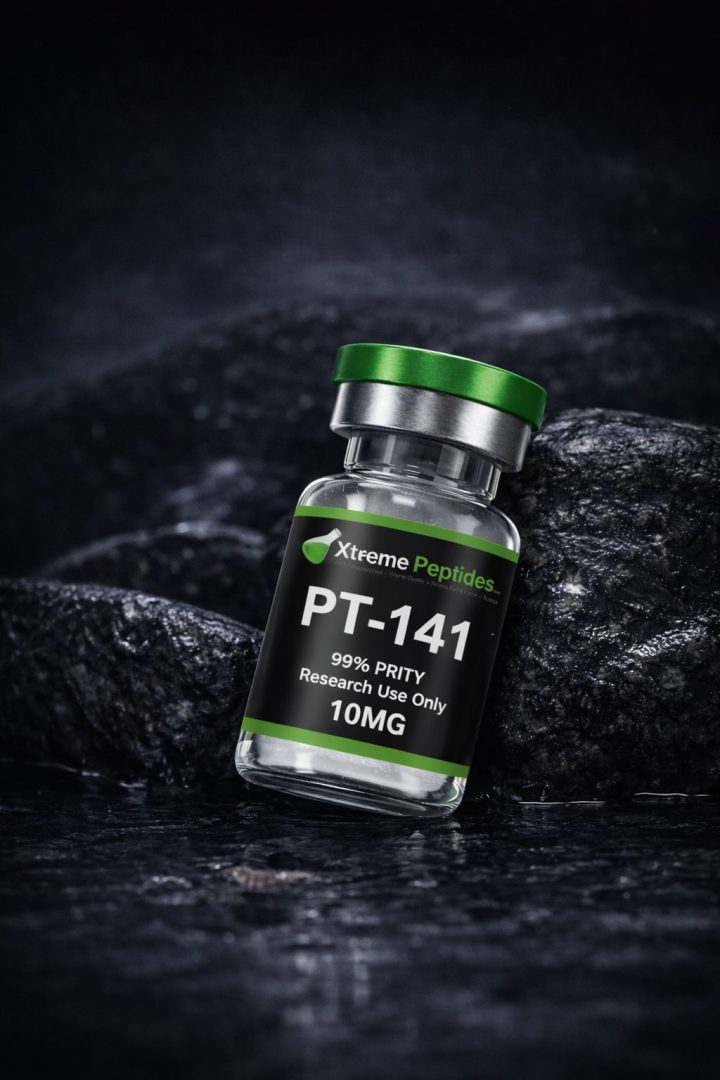
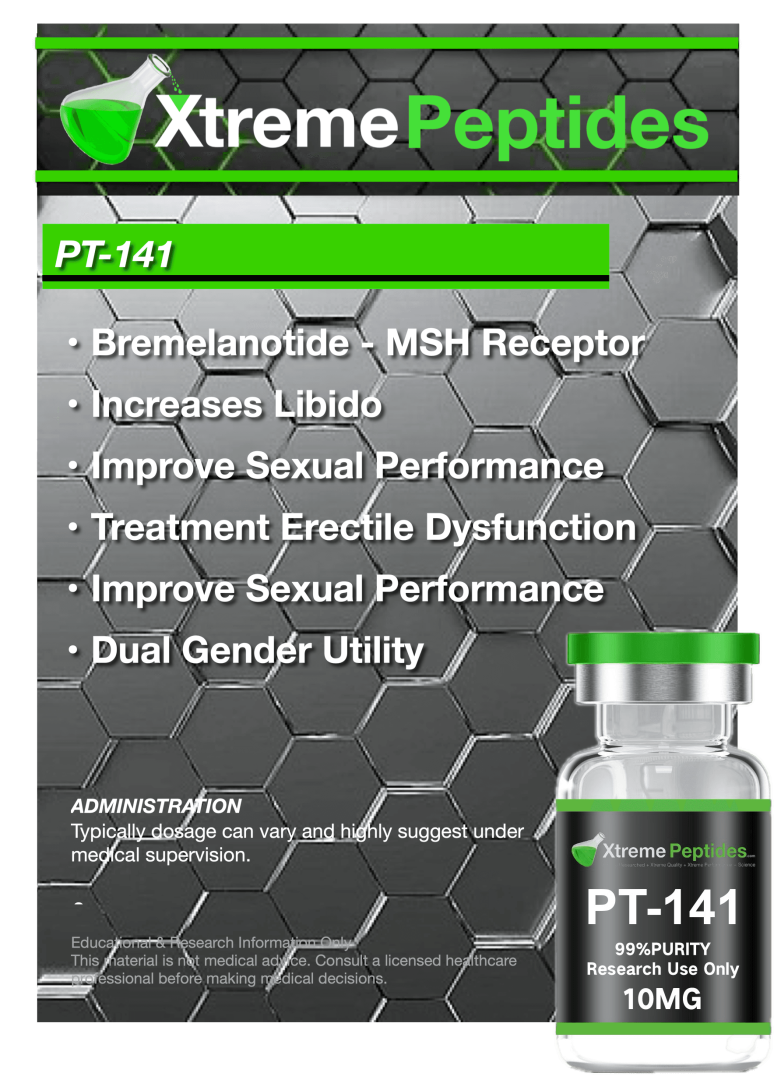
PT-141, commonly referred to as Bremelanotide, is a synthetic peptide derived from the melanocortin peptide family. This class of peptides interacts with melanocortin receptors, which play an important role in neurological signaling pathways and endocrine regulation. As a result, PT-141 has attracted attention in scientific research focused on peptide-mediated cellular communication.
Within laboratory studies, PT-141 functions as a melanocortin receptor agonist and demonstrates activity at receptors such as MC3R and MC4R. These receptors participate in several biological processes associated with neurochemical signaling and regulatory peptide activity. Consequently, researchers often examine how melanocortin receptor activation influences broader signaling networks within neurological systems.
In contrast to peptides that primarily influence vascular mechanisms, PT-141 appears to act predominantly within the central nervous system. Because of this distinction, scientific investigations frequently evaluate how melanocortin receptor stimulation may affect neurochemical signaling, peptide receptor pathways, and related endocrine responses.
Furthermore, PT-141 continues to generate interest within neuropeptide and melanocortin research fields. Laboratory investigations commonly analyze its molecular structure, receptor binding characteristics, and signaling pathway interactions. Through these studies, researchers aim to better understand how melanocortin peptides participate in complex biological signaling systems.
⸻
Chemical Characteristics
Peptide Name: PT-141
Peptide Class: Melanocortin receptor agonist
Molecular Formula: C50H68N14O10
Molecular Weight: ~1025.2 g/mol
Structure Type: Synthetic cyclic peptide
⸻
Research Focus Areas
Researchers frequently explore PT-141 in studies:
•Melanocortin receptor signaling pathways
•Neuropeptide receptor activation
•Endocrine and neurological signaling mechanisms
•Peptide structure and receptor binding dynamics
These investigations help scientists better understand how melanocortin peptides interact with cellular signaling systems.
⸻
References:
- Zheng, Z., Zong, Y., Ma, Y. et al. Glucagon-like peptide-1 receptor: mechanisms and advances in therapy. Sig Transduct Target Ther 9, 234 (2024). https://doi.org/10.1038/s41392-024-01931-z.
- Gwyer D, Wragg NM, Wilson SL. Gastric pentadecapeptide body protection compound BPC 157 and its role in accelerating musculoskeletal soft tissue healing. Cell Tissue Res. 2019 Aug;377(2):153-159. doi: 10.1007/s00441-019-03016-8. PMID: 30915550.
- Pickart L, Margolina A. Regenerative and Protective Actions of the GHK-Cu Peptide in the Light of the New Gene Data. Int J Mol Sci. 2018 Jul 7;19(7):1987. doi: 10.3390/ijms19071987. PMID: 29986520; PMCID: PMC6073405.
- Dominari A, Hathaway III D, Pandav K, et al. Thymosin alpha 1: A comprehensive review of the literature. World J Virol. 2020 Dec 15;9(5):67-78. doi: 10.5501/wjv.v9.i5.67. PMID: 33362999; PMCID: PMC7747025.
- Mellen RH, Girotto OS, Marques EB, et al. Insights into Pathogenesis, Nutritional and Drug Approach in Sarcopenia: A Systematic Review. Biomedicines. 2023 Jan 5;11(1):136. doi: 10.3390/biomedicines11010136. PMID: 36672642; PMCID: PMC9856128.
- Adrian S, Scherzinger A, Sanyal A, et al. The Growth Hormone Releasing Hormone Analogue, Tesamorelin, Decreases Muscle Fat and Increases Muscle Area in Adults with HIV. J Frailty Aging. 2019;8(3):154-159. doi: 10.14283/jfa.2018.45. PMID: 31237318; PMCID: PMC6766405.
- Simon JA, Kingsberg SA, Portman D, et al. Long-Term Safety and Efficacy of Bremelanotide for Hypoactive Sexual Desire Disorder. Obstet Gynecol. 2019 Nov;134(5):909-917. doi: 10.1097/AOG.0000000000003514. PMID: 31599847; PMCID: PMC6819023.
- Aloul KM, Nielsen JE, Defensor EB, et al. Upregulating Human Cathelicidin Antimicrobial Peptide LL-37 Expression May Prevent Severe COVID-19 Inflammatory Responses and Reduce Microthrombosis. Front Immunol. 2022 May 12;13:880961. doi: 10.3389/fimmu.2022.880961. PMID: 35634307; PMCID: PMC9134243.
Reviews
There are no reviews yet.